

Contents
Recruitment still runs on reactive BD and random acts of marketing. It is rarely structured, rarely strategic, and almost never held together by anything more than effort.
You can see it in the daily pattern.
A role lands and the firm scrambles to fill it. A quiet month triggers a burst of calls, posts and good intentions. A record placement gets celebrated but then the board is wiped clean. When momentum is needed, the founder usually supplies it personally.
None of this is an argument for doing less, or for betting everything on one perfect channel. Most firms already do a lot of really good work across the highest-value channels available. The question is whether that work runs by accident or by design: a chaotic blend of whatever it takes, or a deliberate strategy you can measure and improve.
That gap is common. In Resonant's State of BD research, 76% of recruitment firms said they did not have a clearly defined sales plan for how to contact a target client, when and how often. The issue is rarely effort or skill. It is the absence of a commercial strategy that holds the work together. In practice, those firms are still making the seven commercial decisions you are already making — just by default rather than by design.
The question is not whether you do enough. It is whether the work runs by accident or by design.
What commercial strategy means in recruitment
Commercial strategy is the connective tissue between your marketing, your sales, your delivery and your terms of business. It turns a good recruitment business into a deliberate commercial system.
For a recruitment firm, it connects seven decisions:
- Value: the business outcome you create beyond filling a vacancy.
- Audience: the clients, markets and buying situations where that value matters most.
- Offers: the clear ways clients can buy your expertise.
- Routes to market: the processes through which you generate revenue: outbound, inbound, expanding the clients you already have, and partnerships with the suppliers and allies around your market.
- Sales methodology: the process for turning interest into a properly qualified commercial conversation: clarity about what you sell, precision about who you sell to, a campaign that reaches them consistently and conversion that closes without discounting.
- Delivery: the experience that proves the promise, drives the real value and creates repeatable proof.
- Value capture: the pricing, terms, scope and account-expansion choices that make growth worthwhile.
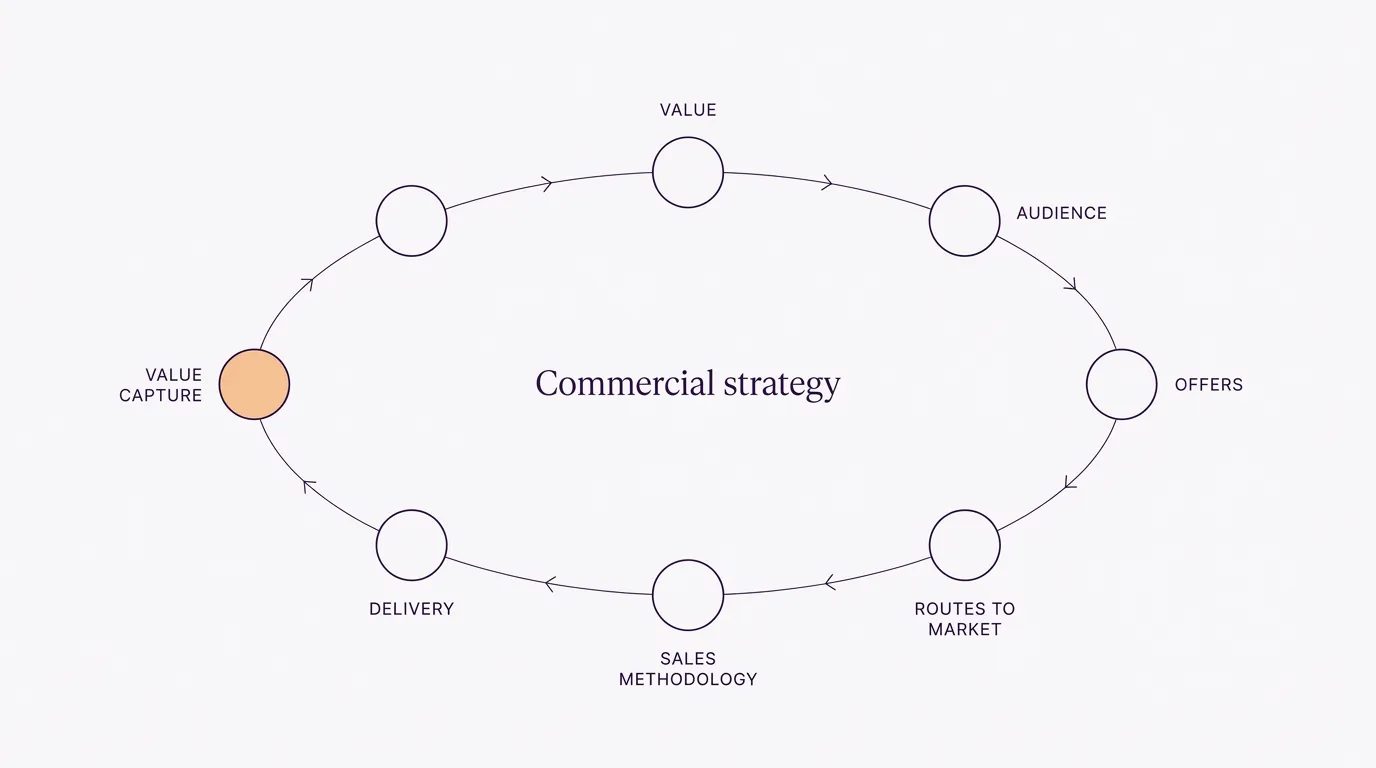
When these decisions reinforce each other, growth gets easier to repeat. When they do not, marketing attracts the wrong conversations, sales relies on individual heroics, delivery carries promises it did not help shape and margin gets squeezed after the deal is won.
Why the work never quite joins up
Most recruitment founders are not short of ideas. They may have a strong niche, loyal clients, capable consultants and an active LinkedIn presence. But those ingredients do not automatically form a strategy.
A firm might describe itself as specialist while selling the same contingent service as everyone else. It might publish useful content but have no defined route from attention to conversation. It might train consultants to sell better without agreeing what they are selling, to whom, or why the client should choose them now.
I see it all the time. Expert recruiters with long tenure competing on fees for contingent work rookies go on to fill. Meanwhile, consulting fees, recurring revenue, or even retainers feel out of reach.
That creates a fragile form of growth. Good months depend on luck, a single relationship, a live vacancy or an exceptional individual. Plenty of motion, very little momentum. Read why the economics of transactional recruitment are becoming harder to sustain.
Yet in most firms the raw material already exists. Good recruitment firms create more value than they recognise or capture: the insight, the market knowledge, the commercial judgement. It is there, but it is never made explicit, so the market cannot pay for it.
Good recruitment firms create more value than they capture. The market cannot pay for what it cannot see.
What changes when the commercial system joins up
A clear commercial strategy does not mean a bigger marketing plan or a longer sales script. It means the firm can make consistent choices.
It knows which clients it is built to help and which opportunities to leave alone. It can explain its value in language clients recognise. It gives consultants a repeatable path from first conversation to paid work. It produces delivery proof that makes the next sale easier. And it protects the value the firm captures through stronger scope, fees and terms.
The result is not overnight certainty. It is better clients, stronger fees, less wasted effort and a business that can repeat what works. Crucially, it gives you a process for winning that everyone in the business can run, measure and improve.

That is what joining the system up looks like in practice. When Skillsearch worked with Resonant on exactly this, Richard Fisher described the outcome:
"Off the back of it we have, probably for the first time, a strategy and structure company wide for BD."
The moments that make this hard to ignore
Most firms do not see this in theory. They see it on the desk, or in a meeting, at a clear point in their journey.
- About to make a commercial investment: a senior hire, a new market, a tool or a campaign, with no reliable way to know it will pay. There is no data to provide evidence.
- Busy but not getting stronger: plenty of work, decent months, and a business that is not visibly compounding. The effort isn't improving profit.
- Founder stepping back: the founder wants to step away from leading sales and feels they can't. Revenue still depends on their relationships, energy and standards. When they aren't there it falls apart.
- Selling beyond recruitment: moving into retained, advisory or consulting work, where the old BD habits do not fit the new offer. The team get discouraged when no-one seems to buy the more sophisticated product.
- Exit, MBO or leadership handover: the commercial engine has to be provable to someone else, not just felt by the founder. Someone is asking what the business is worth.
Founders reach the conclusion at different points in their journey. Some are built around it. Others only get there too late. But the strategy gap becomes clear sooner or later. The founder reaches a commercial inflection point, where the way revenue gets created has to become deliberate.
How to start
Start with a commercial diagnosis, not a new campaign. Ask four questions:
- Where does the firm create value that clients do not yet fully understand or pay for?
- Which audience and buying trigger should the business be known for?
- What is the clearest offer and sales route for that audience?
- Where do the current marketing, sales and delivery journeys break apart?

You do not need to fix all of it at once, and you should not try. You need one shared picture of how the firm will create profitable revenue, then the discipline to work it in sprints: one component at a time, starting with the gap that is costing you most.
In our work this diagnosis runs across three lenses: position, process and payload. The labels matter less than the honesty of the answers. If you want a structured way to work through them, that is exactly what the Commercial Strategy Workshop is for.
The next step
The aim is simple: replace disconnected activity with one commercial strategy that strengthens the business, rather than masking the gaps.
Questions recruitment leaders ask
Commercial strategy is the connective tissue between your marketing, your sales, your delivery and your terms of business. It is the set of decisions that determines how your firm creates revenue on purpose: the value you offer, the clients you aim at, the routes you take to market, the way you sell, the way you deliver and the way you capture value. It turns a good recruitment business into a deliberate commercial system.
BD is one route to revenue. Commercial strategy decides where revenue comes from at all, and holds every route together. A firm can be busy with BD and still have no commercial strategy: plenty of calls, posts and effort, but no shared picture of how the business creates profitable revenue. Strategy is what makes BD deliberate rather than reactive.
Because activity and progress are not the same thing. Most firms already do really good work across the highest-value channels. If that work runs by accident rather than by design, good months depend on luck, a single relationship or an exceptional individual. Plenty of motion, very little momentum. A commercial strategy is what turns effort into compounding strength.
Start with a commercial diagnosis, not a new campaign. Ask where the firm creates value that clients do not yet pay for, which audience and buying trigger you should be known for, your clearest offer and sales route, and where the marketing, sales and delivery journeys break apart. Then work the gaps in sprints, one component at a time, starting with the one costing you most.
No. Most firms already touch every route to revenue they will ever use: outbound, inbound, expanding existing clients and partnerships. The goal is not one perfect channel. It is five deliberate ones instead of five accidental ones. Strategy decides the mix; it does not amputate it.
Yes, for a while. Fragile growth is still growth. The problem is that it cannot be repeated on purpose, measured or improved, and it tends to mask the gaps until a key moment exposes them: an investment decision, a founder stepping back, a move beyond contingency, or a sale of the business. Strategy is what makes growth strengthen the firm rather than hide the cracks.